An evolving digital learning platform that connects practice, feedback and revision. First developed as Royal Academy, UNIO brings together my work as a designer, educator and lifelong learner.
What happens after a learner gets something wrong?
A learner may watch a lesson, answer a quiz and receive a score, yet still be unsure what to do next. My Major Project explored this gap: how to connect self-study, feedback and guided support into a clearer learning pathway. The original Royal Academy prototype focused on desktop. I now call this developing platform UNIO, with a broader ambition to make practice, vocabulary and revision feel continuous.
02 / DESIGN REASONING
The thinking behind the interface.
01
Make the next action visible
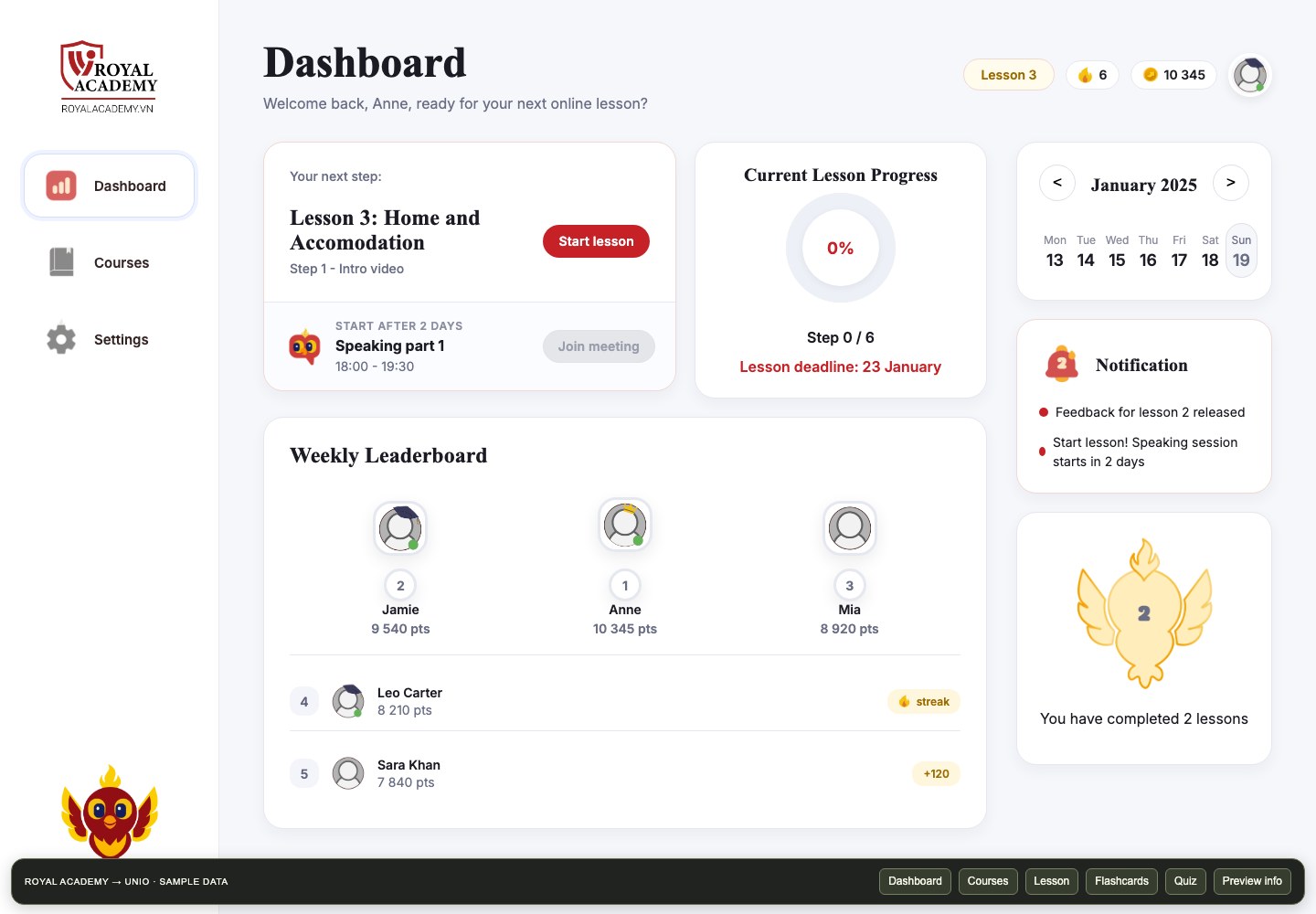
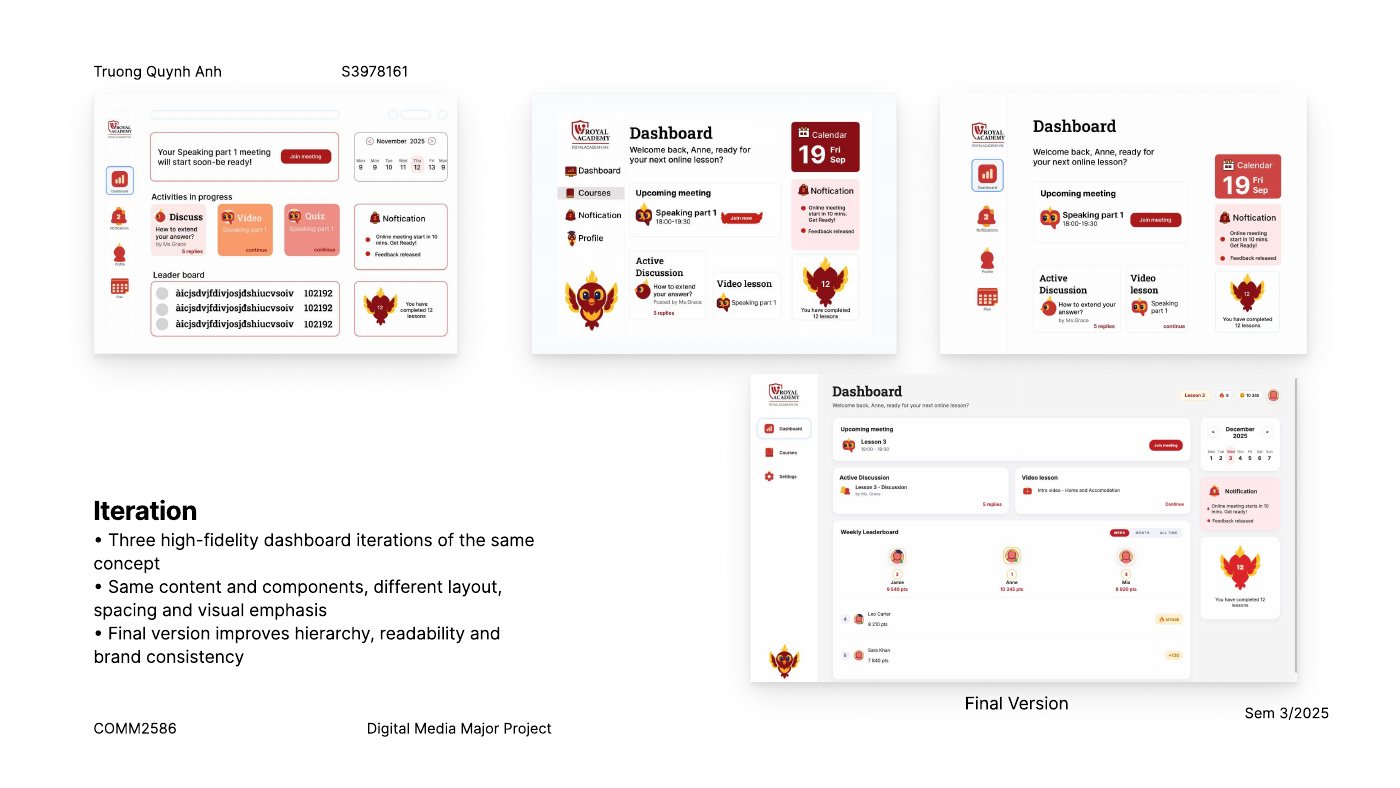
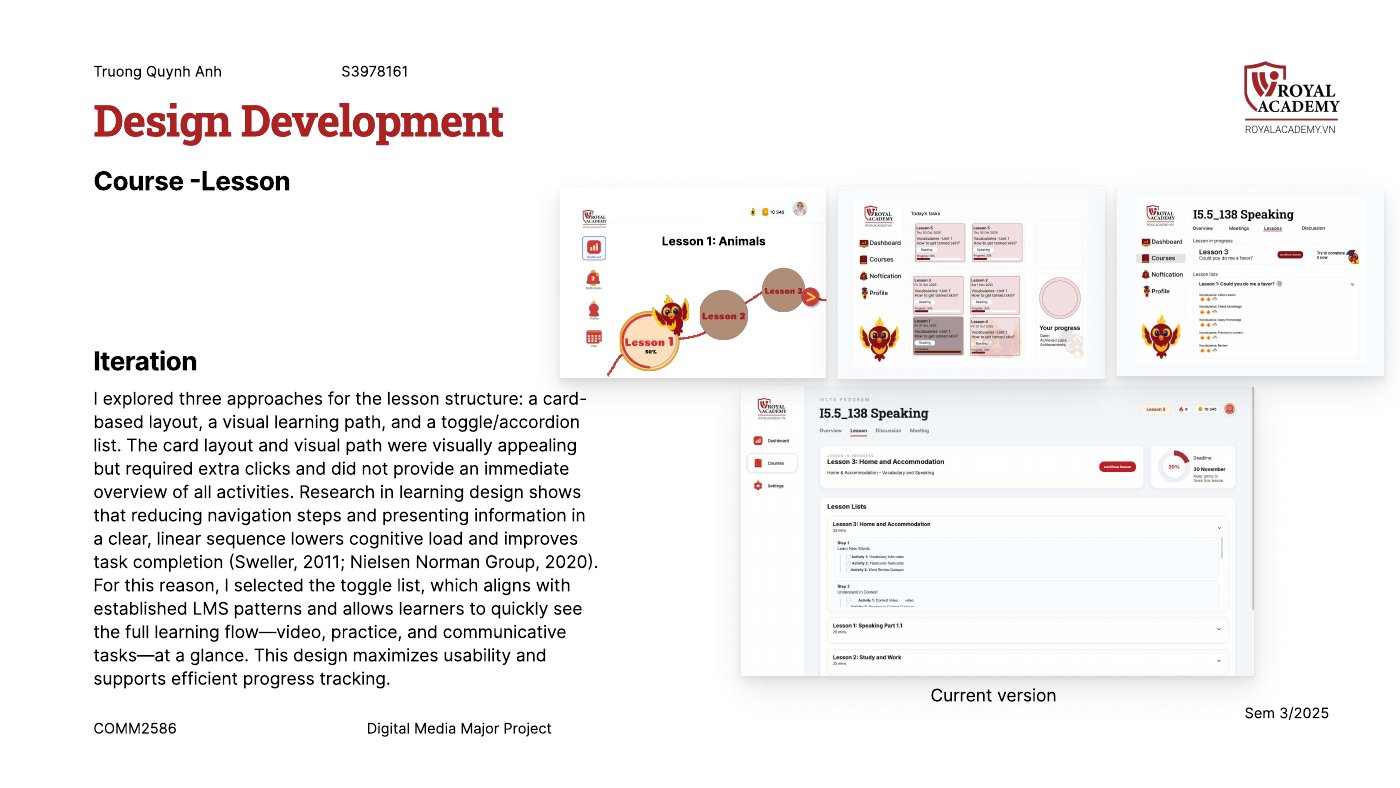
The dashboard leads with “Your next step”, bringing the current lesson and progress into the same place. The process journal records several dashboard and lesson-page iterations as I worked to make the route through the course easier to read.
02
Connect activities with a learning purpose
The proposed pathway moves from vocabulary and context into self-check, sharing and speaking practice. Community of Inquiry, Cognitive Load Theory and Bloom’s taxonomy informed the design rationale; the project explores how to apply them through interface structure rather than claiming measured learning gains.
03
Treat feedback as a route back into learning
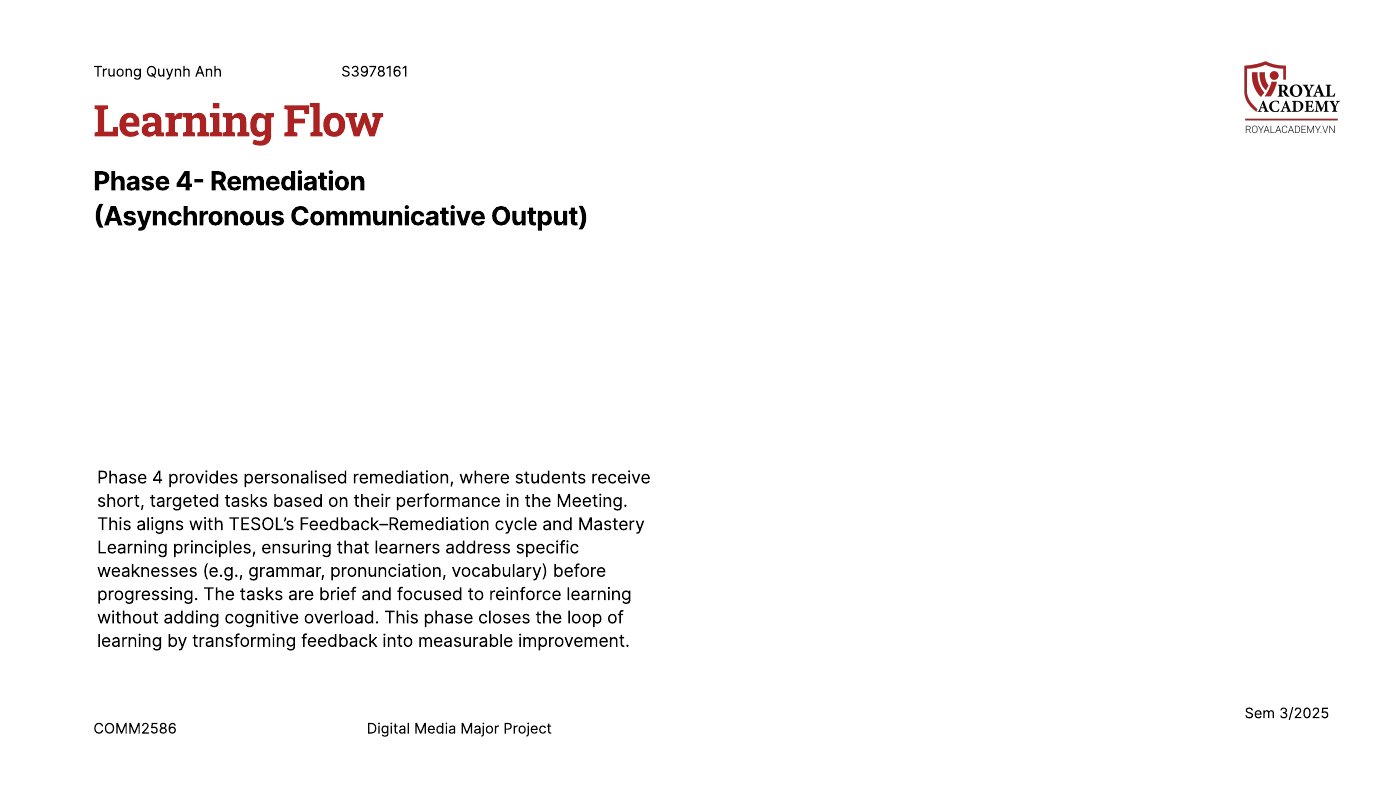
The remediation concept links difficulty with a further learning action. That question continues in UNIO today: how could a learner move from a mistake to understanding, targeted practice and later review? This is the product direction; the portfolio preview demonstrates a bounded set of original screens and activities.
The experience, step by step.
A walkthrough of the documented experience.
01
Orient
Find the next lesson on the dashboard.
02
Understand
Meet vocabulary and context.
03
Practise
Use flashcards and a quick check.
04
Review
Identify what still needs attention.
05
Apply
Carry learning into a new situation.
03 / VISUAL EVIDENCE
A closer look at the work.
Original screens and process material. Select an image to inspect it at full size.
Major Project process journal, p. 29: three dashboard iterations, working toward a clearer relationship between the next task, progress and supporting information.
The current UNIO mascot from examprep.ver2. A small, encouraging presence connects the newer identity with the learning experience.
04 / EXPLORE
From explanation to experience.
Explore the original Royal Academy desktop interface: dashboard → courses → lesson, then try the flashcards and quiz from the preview menu. Activity content and progress are local examples. The original name is retained inside the preview to show where UNIO began; video, discussion, meetings and accounts are outside this guided version.
Supervisor feedback helped me narrow the Major Project from a broad collection of discussion and meeting features toward a coherent learning pathway. That focus remains useful as UNIO evolves. The newer examprep.ver2 direction includes IELTS skill practice, My Plan, My Progress and a Language Bank. My current MA in English Language Studies at Hoa Sen University gives me another lens for asking how these parts can support learner autonomy. The next challenge is to evaluate the learning loop with learners, rather than assume that a connected interface alone improves learning.